

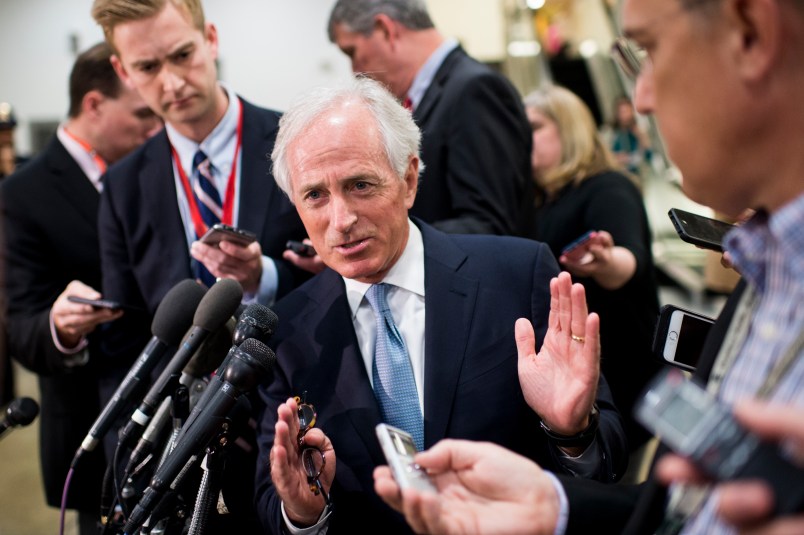
Senators from both parties mostly rallied behind President Donald Trump’s surprise strike Thursday night on a Syrian airfield, but many cautioned that any further military action deserved their input.
“He was responding to a chemical attack that was an atrocity, outrageous, and a response was appropriate,” Sen. Ben Cardin (D-MD), the top Democrat on the Senate Committee on Foreign Affairs, told reporters Friday at the Capitol.
“We need a coordinated strategy articulated by Mr. Trump, as to what our policy is in Syria. If that’s going to require action by Congress, he should submit to us his request. He has not done that,” Cardin later added. “He should consult with Congress, he has not done much consulting. So that’s what he should be doing.”
With the U.S. House already in recess, the Senate remained in town Friday for their Supreme Court confirmation vote, and had to weigh in on a strike that few lawmakers saw coming and that represented a drastic change in Trump’s posturing towards the Middle East.
Not many senators questioned the legality or the merits of the strike as a one-off action to punish Syria for the apparent use of chemical weapons by Bashar al-Assad’s regime, but they awaited an afternoon briefing with Trump administration figures to see if the measure was part of a larger shift in the U.S. military approach to Syria. A few lawmakers suggested they would be willing to give Trump carte blanche for his next moves, but most asserted the role that Congress plays in influencing greater strategic action.
“It has been a longstanding understanding that the commander-in chief has the authority…to respond to an immediate threat,” Sen. Ted Cruz (R-TX) told reporters. “At the same time, the constitutional authority to declare war is given to Congress, and so if there are to be protracted military engagement, that decision has to be made by Congress.”
Congress now must grapple with the role it will take in the Trump administration’s military strategy, after years in which members slammed former President Obama for acting militarily without their approval while Obama was unable to get a congressional floor vote on what’s known as Authorization for Use of Military Force (AUMF) to launch a strike in Syria.
“There’s no point in a AUMF today,” said Sen. Bob Corker (R-TN), the chair of the Foreign Affairs Committee who pushed for an AUMF under the Obama administration. “[Trump] acted under the existing authority he as a commander-in-chief under Article II, but if there is going to be added activities, then obviously we would need to do that.”
Corker added that there was “no indication” yet that further military action was coming down the pike.
Even Democrats were willing to say Friday that Trump, under the Constitution and previous military authorization measures, had some leeway to take military action like the strike he ordered Thursday night.
“I think it’s perfectly appropriate to take punitive action against the Assad regime for their use of chemical weapons,” said Sen. Chris Van Hollen (D-MD). “But any further military action especially as it relates to ground troops would require a full congressional debate.”
The sentiment that Trump would need to get Congress involved for any expansion of military action was a bipartisan one.
“Any further action—I’d like to see Congress involved, and also, very importantly, what’s our end game, what are we trying to achieve,” Sen. John Boozman (R-AR) told reporters.
Trump did have a few cheerleaders in the Senate who seemed ready to go along with whatever agenda he had to offer on Syria.
“He doesn’t need an AUMF to act in the national security of the United States. He doesn’t. He is the commander-in-chief and he has the right to act expeditiously to address a threat,” Sen. Marco Rubio (R-FL) told reporters. “He has a right to defend us every single time.”
Sen. Roy Blunt (R-MO) didn’t even think it was necessary for Trump to brief the public on his next moves.
“I don’t think anybody benefits from the President explaining what we might do,” Blunt said. “It’s important that both the Syrians and Russians wonder about what we might do.”