

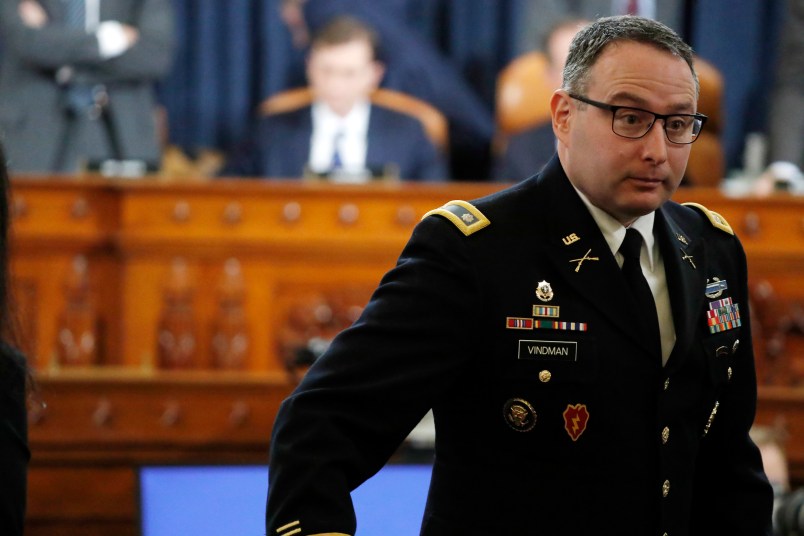
One of the interesting themes of these hearings is the question of who controls US foreign policy: the President or the sum of the “interagency” or bureaucratic policy making process. In a narrow sense it is absolutely right that if all the President’s advisors (in the sense of the sum of everyone at State, DOD, the NSC, Intelligence Community, etc) decide on one policy and the President disagrees, the President’s choice governs. This is elementary. And if you listen to the various testimonies no one who has spoken as a witness has said otherwise. But there’s a part of this that bears closer examination. Because it gets at the underbelly of so-called theories of “unitary executive” power.
 Members-Only Article
Editor's Brief
The Underbelly of ‘Unified Executive Authority’
|
November 19, 2019 3:22 p.m.
This is a members-only article
Small Team. Big Results.
We’re proud of what our small newsroom has accomplished and it’s not hyperbole when we say that without our members, none of this would be possible.
Free memberships available for students and those experiencing financial hardship.
Already a member? SIGN IN